Tuesday, January 5, 2010

2010--Time to Come Out Kickin’


With all the DA visits and FCAT approaching, it’s time to Kick It Up A Notch! Make sure you are mentoring and giving feedback.  Where should you start?  Here are a few suggestions:
1.  Are your teachers writing measurable objectives?  Be sure to check objectives in your teachers’ lesson plans.  Remember, objectives need to have a measurable verb.  Make sure teachers are not using terms like: to know, to understand, or to appreciate.   If the teacher’s goal is for students to produce a book report, this is an activity. 
Objectives should be instructions about what teachers want the student to be able to do and what degree the students will be able to demonstrate mastery of the task.  Do objectives reflect high levels of cognition according to Bloom’s Taxonomy?

2. Are Test Specifications being utilized?  Why not print the test specifications for students?   Teachers could use the latest BAT data and print the specs for what most students missed.  Students could read the benchmark, check out how the benchmark will be assessed, see a list of distracters that could be used, and then try to answer a sample question.  Also, your PLCs should be sharing ways to use Test Specifications.

3.  Are word walls student generated? Word Walls take time.  Remind your teachers that great web resources are available for students to use for their words.  Introduce your teachers to the following websites:
• Visuwords™ online graphical dictionary  Look up words to find their meanings and associations with other words and concepts. Produce diagrams reminiscent of a neural net. Learn how words associate.
• Shahi is a visual dictionary that combines Wiktionary content with Fickr images.
• Wordle generates “word clouds” from text that you provide. The clouds give greater prominence to words that appear more frequently in the source text. You can tweak your clouds with different fonts, layouts, and color schemes.
(Links to these websites are listed under Kick It Up A Notch Resources on the right-hand side of this blog entry.)

I hope this will give you a starting place for mentoring and giving feedback for the next month.  If you have any Kick It Up A Notch suggestions for mentoring and giving feedback that you have used at your school, please share.  


Monday, November 16, 2009

DOE Visits and IRT Walkthroughs

Many schools are scheduled for DOE visits while others are still waiting for the first IRT walkthrough. I’ve been receiving feedback from many
of the schools that have had the IRT visits.
The visits focus on the following topics:
• Classroom Environment Conductive to Teaching and Learning
• Materials Support a High Level of Teaching and Learning
• Higher Order Questioning and Thinking is Evident
• Instruction Engages Students
• Small Group, Differentiated Instruction is Utilized
to Address Students’ Instructional Needs
• Reading and Writing Activities are Evident Across the Curriculum
• School and District Leadership and Coaching is Evident

The visits seem to have a common thread. Comments are generally about
•deciding on a process for data chats/progress monitoring discussions with students
•making sure students are exposed to grade level work regardless
of ability level and
•making sure PLCs are scheduled bimonthly and aligned to SIP plan
•developing consensus across the curriculum for a common board
configuration
• having an interactive word wall (student-made).

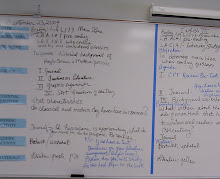
The photo (on the right) is from a school that uses the following configuration:
-Date
-Benchmark
-Objective
-Agenda
-Essential Question
-Opening Activity
-Closing Activity
-Materials or Homework

Notice that this teacher used blue tape to separate her classroom periods.
I understand that classroom word walls need to be interactive and need to be made by students.
I’d really like to hear feedback from other schools that have had visits.
Please post your experience.

Thursday, October 15, 2009

A message from the Director…

The Leadership Department has been given the task of aligning all Principal and Assistant Principal trainings districtwide.

At first, this seemed like an unrealistic task. Due to the effective collaboration between HRD and Area Directors, quality staff development for all Broward County Administrators has been aligned. We have ensured collaboration, consistency and fidelity of implementation across Area Principal and Assistant Principal PLCs. The goal was to develop a process that strengthens the learning of all leaders. This year’s focus is on how to raise achievement of all students, while integrating the understanding and utilization of data to impact student performance across all subgroups to ultimately meet AYP requirements.

Please share how this process is assisting you in meeting your School’s SIP and meeting your subgroup targets? What have you learned from your colleagues that you have been able to take and implement back at your school? What are you doing differently this year to help you meet AYP?

Friday, September 18, 2009

2009-2010 AYP Strategies

Schools struggling with AYP should look to the example of dozens of their counterparts around them that have taken a personal approach to raising test scores. Instead of applying broad academic policies and sending teachers to statewide conferences to learn about new teaching methods, these schools use data to gauge student progress at any point during the school year, and then use the information to customize curriculum and instructional programs. The data informs the schools when and where interventions are necessary.

What strategies will you use to attain 72% scoring at or above grade level in Reading?

What strategies will you use to attain 74% scoring at or above grade level in Math?

Monday, August 10, 2009

What is Response to Intervention? (RtI)

Response to Intervention (RtI) provision included in the 2004 re-authorization of the Individuals with Disabilities Education Act (IDEA) is one of the most significant recent developments in education, requiring a renewed focus on collaboration among general and special educators in order to promote the achievement of struggling learners. RtI is an approach that instructs and monitors the progress of all students to ensure they receive interventions, supports and accommodations as needed to meet local, state, and national standards (Yell & Drasgow, 2007). The model is predicated on a set of assumptions that includes the use of scientifically-based curricula in the general education setting, regular administration of universal screenings, use of a problem-solving or standard-protocol approach to making data-based decisions, identification and use of a tiered system of intervention and support, assurance of fidelity in the delivery of instruction and targeted interventions, and ongoing progress monitoring for identified students (Fuchs et al, 2005; Fuchs & Deshler, 2007; Fuchs, Fuchs & Prentice, 2005). Students who fail to make progress within the RtI model may be referred for a special education evaluation, with available data being used to documents the presence of a learning disability (Batsche et al., 2006; Gresham, 2002; Peterson & Shinn, 2002). RtI would be infused across both VEIN priorities as an effective early intervention strategy for regular classroom teachers.

Tuesday, June 2, 2009

What about Departmentalization?

We've discussed departmentalization on the video conference today.  We know that departmentalization will:

  • Provide the opportunity to intensify the focus on the need to meet standards, indicators and benchmarks of the curriculum.
  • Allow teachers to specialize in a specific subject area and to maximize the use of resources/instructional time.
  • Offer academic specialization and takes advantage of the best of teacher resources and facilitates instructional planning.
  • Provide the opportunity for incoming teachers to narrow their focus to a specific content area.
  • Provide the school with the opportunity to maximize the use of district and other resources.
  • Provide instruction of a higher quality since teachers are focused on specific subject-matter discipline and can concentrate on preparing comprehensive lessons that are structured around making the needs of individual sub-groups. 
How do you feel?  What concerns do you have?  Please post!